Turn an old phone into a walking reminder robot
PhoneBot is a knee-high walking robot from UCLA that uses an old Android phone as its eyes and brain. This plan aims it at one job: walk over when it's time, face you and show the reminder. About $537.80 in parts, plus the phone.
Prices and links checked Oct 24, 2026. Where we couldn't confirm something, we say so.
You can now use your old Android phone as the brain of a bipedal humanoid robot. UCLA researchers built PhoneBot a 48 cm robot with 13 motorized joints. The phone handles vision and walking control.
— Techniahqrobot (@techniahqrobot) October 11, 2026
What works and what doesn't
Shown working in UCLA's lab
Walking on a flat floor, following a person the phone's camera can see, turning the torso to face them, showing things on the phone screen, and talking back through a laptop on the same Wi-Fi. The authors ran this on a 2017 phone and on $50 to $90 prepaid ones.
A stretch
The reminder itself. Nobody has published a PhoneBot that wakes up at 8 a.m. and goes looking for you, so the timing and the 'go find a person' logic are yours to write. Finding you in another room is harder still. The phone can map with ARCore, but walking room to room wasn't shown.
Not solved
Stairs, rugs and door thresholds, since it was trained on flat ground. Handing you pills, since it has no arms. And you can't run any of it until the PhoneBot code is public. On Oct 24, 2026, only the hardware files were.
Why PhoneBot
A phone already has a camera, an IMU, a processor, Wi-Fi, a screen and a speaker. PhoneBot uses all of them, so the robot body is just 13 servos, a small computer that drives them, a battery and printed parts. It stands 48.3 cm tall and weighs 1.8 kg with the phone. The authors put the parts at about $400 without the phone. A 30-second clip of it shared by Brian Roemmele on Oct 23 had over 130,000 views by the next morning. The idea builds on OpenBot, which put a phone on a wheeled base.
phonebot.dev, PhoneBot paper (arXiv 2610.08737), Robotica Guide
See how it goes together
Two six-joint legs hold up a pelvis. A torso joint on a thrust bearing lets the top half turn to face you. The battery, the Radxa computer and the servo adapter sit in the torso, and the phone clips into a mount on top. The phone isn't wired to anything. It sends joint targets to the Radxa over Wi-Fi.
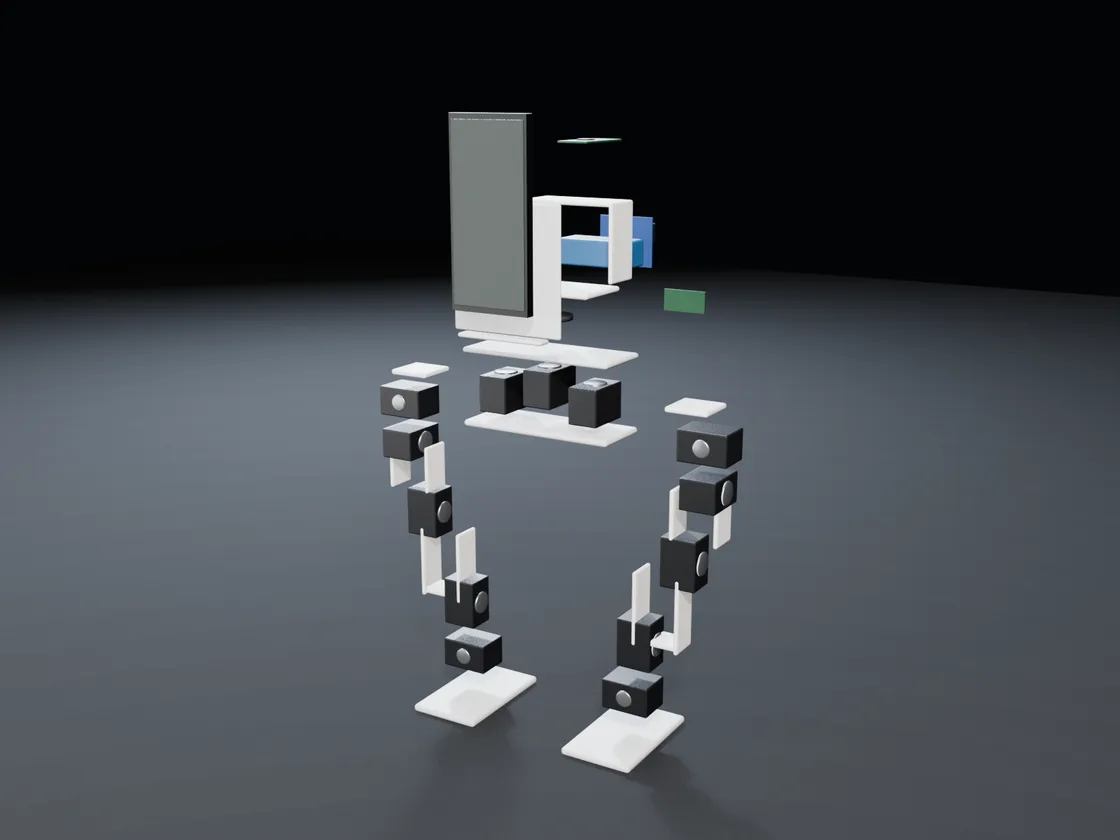
The main parts, from the floor up. Same simple model.
- 1Your old Android phone. Camera, motion sensor and computer in one. It plans each step
- 2Phone mount. Printed holder that keeps the phone upright on the torso
- 3Radxa ZERO 3W. Small Linux board that passes the phone's commands to the servos
- 4U2D2 and power hub. ROBOTIS USB adapter and power board for the servo bus
- 53S LiPo battery. 2200 mAh pack. It powers the servos and, through the converter, the Radxa
- 6LM2596 converter. Steps the battery down to 5 V for the Radxa board
- 7Electronics frame. Printed frame for the boards and battery
- 8Torso base. Printed plate the frame sits on
- 9AXK2542 thrust bearing. The torso yaw joint turns on it
- 10Printed pelvis. Holds the hip servos
- 11XL430-W250-T servos. 13 of them. They're the joints and the biggest cost
- 12Hip brackets. Printed brackets at the top of each leg
- 13Printed leg links. Connect the servos down each leg
- 14Printed feet. Flat feet. The robot walks on flat floors only
What it replaces
Here's what a reminder costs today, from a free alarm to a home robot.
| Option | Price | What it does | Notes |
|---|---|---|---|
| Phone alarm or smart speaker | Free with a device you have | Rings or speaks at a set time | Easy to miss from another room, and it can't come find you. |
| Hero pill dispenser | $29.99 to $59.99 a month | Sorts and dispenses pills, with alerts | From $29.99 a month on a 12-month prepaid plan, $44.99 with a 12-month commitment, or $59.99 with no commitment. Sits on a counter.Hero |
| ElliQ | $249.99, then $49.99 to $59.99 a month | Tabletop companion with medication reminders | Talks and reminds, but doesn't move.ElliQ, ElliQ features |
| Amazon Astro | $1,599.99 | Wheeled home robot with reminders | Invite-only. It drives between rooms on wheels.Amazon |
| This build | About $537.80 plus an old phone | Walks over, faces you, shows and says the reminder | No arms, flat floors only, and the robot code isn't public yet.phonebot.dev, PhoneBot paper (arXiv 2610.08737) |
Parts
USD, as listed on each store page on Oct 24, 2026. $537.80 total, before shipping and tax. That's more than the authors' $400 mostly because the servos cost more now and some parts only come in packs. Add the phone and a LiPo charger if you don't have them.
| Part | Qty | Price | Source |
|---|---|---|---|
| DYNAMIXEL XL430-W250-T servoSix per leg and one for the torso. The paper priced them at $23.90, and ROBOTIS lists them higher now. | 13 | $27.50 each, $357.50 | ROBOTIS ↗checked Oct 24, 2026 |
| U2D2USB to servo bus adapter. The onboard computer talks to the servos through it. | 1 | $36.92 | ROBOTIS ↗checked Oct 24, 2026 |
| U2D2 Power Hub Board setFeeds battery power to the servo bus. | 1 | $21.85 | ROBOTIS ↗checked Oct 24, 2026 |
| Radxa ZERO 3W, 2 GB, soldered headerThe onboard computer (SKU RS107-D2E0H1W15, as in the PhoneBot BOM). It takes joint targets from the phone over Wi-Fi. Other memory options cost less. | 1 | $39.99 | Arace ↗checked Oct 24, 2026 |
| LM2596 buck converter, 5-packSteps the battery down to 5 V for the Radxa. You need one. | 1 pack | $7.99 | Amazon ↗checked Oct 24, 2026 |
| Zeee 3S 2200 mAh LiPo, 2-packPowers the servos. You need one, so the second is a spare. A LiPo charger isn't included. | 1 pack | $34.19 | Amazon ↗checked Oct 24, 2026 |
| PLA filament, 1 kgFor the 19 printed parts: feet, leg links, pelvis, torso, electronics frame and phone mount. | 1 roll | $14.99 | Bambu Lab ↗checked Oct 24, 2026 |
| Screws, standoffs, heat-set inserts, AXK2542 thrust bearingThe PhoneBot BOM's per-piece cost for M2, M2.5 and M3 screws, inserts, standoffs and the torso bearing. Whole packs cost more. | 1 set | $24.37 | PhoneBot BOM ↗checked Oct 24, 2026 |
Step by step
1. Get the files and read the license
phonebot.dev has the parts list, Onshape CAD, STEP files, printable parts and an assembly tutorial. They're CC BY-NC 4.0, so building one for yourself is fine. Selling builds needs permission from the authors.
2. Pick a phone
The authors tested a 2017 Honor 9 and three prepaid phones that cost about $50 to $90: moto g 2025, Galaxy A16 5G and moto g 2024. ARCore mapping needs Google services, which the Honor 9 doesn't have in the US. The phone isn't wired to the robot. It talks to the onboard computer over Wi-Fi.
3. Print the body
Print the feet, leg links, hip brackets, pelvis, torso base, electronics frame and phone mount in PLA. The BOM counts 19 printed pieces from 11 designs.
4. Set up the servos and build the legs
Give each of the 13 XL430 servos its own ID before it goes into the body. ROBOTIS's DYNAMIXEL Wizard does this through the U2D2. Then follow the assembly tutorial: six joints per leg, plus a torso yaw joint that sits on the thrust bearing.
5. Wire the power and the computer
The 3S battery powers the servos through the power hub. The LM2596 turns that into 5 V for the Radxa ZERO 3W. The Radxa talks to the servos through the U2D2 over USB. Set the converter to 5 V with a meter before you plug in the board.
6. Load the software
On Oct 24, 2026 the PhoneBot site had a Code button that didn't link anywhere, and we couldn't find the phone app or the walking policy anywhere public. Until they're out, you can move the joints from the Radxa with the DYNAMIXEL SDK, but it won't walk. Watch phonebot.dev for the release.
pip install dynamixel-sdk
7. Add the reminder
This part is yours to write. At a set time, the phone starts following the nearest person it can see, turns the torso to face them, and shows the reminder on screen. In the paper, speech goes through a laptop on the same Wi-Fi running whisper.cpp, a language model and Piper, and the phone's camera finds people with ML Kit and MediaPipe.
8. Test it on a flat floor
Run it on a clear, flat floor first. Keep it away from stairs and rugs, and keep a normal phone alarm as the backup.
What's hard
The robot code isn't out yet
The paper says the hardware and software are released, but on Oct 24, 2026 we found only the hardware files. Without the walking policy, it won't walk.
How to help: If you find the code, tell us and we'll update the plan.
Flat floors only
The walking policies were trained on flat terrain. The authors list uneven ground as future work. Stairs, thick rugs and door thresholds are out for now.
How to help: Film what happens at a rug edge or threshold and share the result with the authors.
No arms, little payload
PhoneBot has no arms, and the servos' limited torque limits what it can carry. It can remind you about pills but can't carry them to you.
How to help: Arms are on the authors' list. A light, printable arm would help.
Finding you in another room
The paper shows following a person the camera can see, and ARCore mapping that stays stable while it walks. It doesn't show walking room to room to find someone.
How to help: Try saving a map of your home with ARCore and sending the robot to named spots.
Talking needs a laptop
Speech-to-text and the language model run on a laptop on the same Wi-Fi.
How to help: Test a small on-phone speech model and report the delay.
It's not a medical device
This is a research robot. Don't make it the only way someone remembers medication.
How to help: Keep a phone alarm or pill dispenser running alongside it.
What we couldn't confirm
- When the PhoneBot phone app and walking code will be public.
- How long it runs on one battery. The paper doesn't say.
- Prices for the small screws, inserts and bearing. We used the PhoneBot BOM's per-piece figures.
- Whether one 1 kg roll covers every print, with supports and failed prints.
- We haven't built one. Prices change, so check the source before you buy.
Credit and license
PhoneBot is by Ruochen Hou, Quanyou Wang, Daniel Koh and Dennis W. Hong at the Robotics and Mechanisms Laboratory (RoMeLa), UCLA. Its CAD, parts list and assembly guide are released under CC BY-NC 4.0. We didn't use their CAD on this page. The 3D model above is our own, sized from their published numbers.
phonebot.dev, PhoneBot paper (arXiv 2610.08737), CC BY-NC 4.0