How to build a laundry-folding robot
You can't buy a home robot that folds laundry yet. You can build one that folds a towel, with two open-source arms, a laptop and about $550 of parts. Shirts are possible too, but the best open result took a team months and a $6,500 robot.
Prices and links checked Oct 23, 2026. Where we couldn't confirm something, we say so. Can you buy one yet?
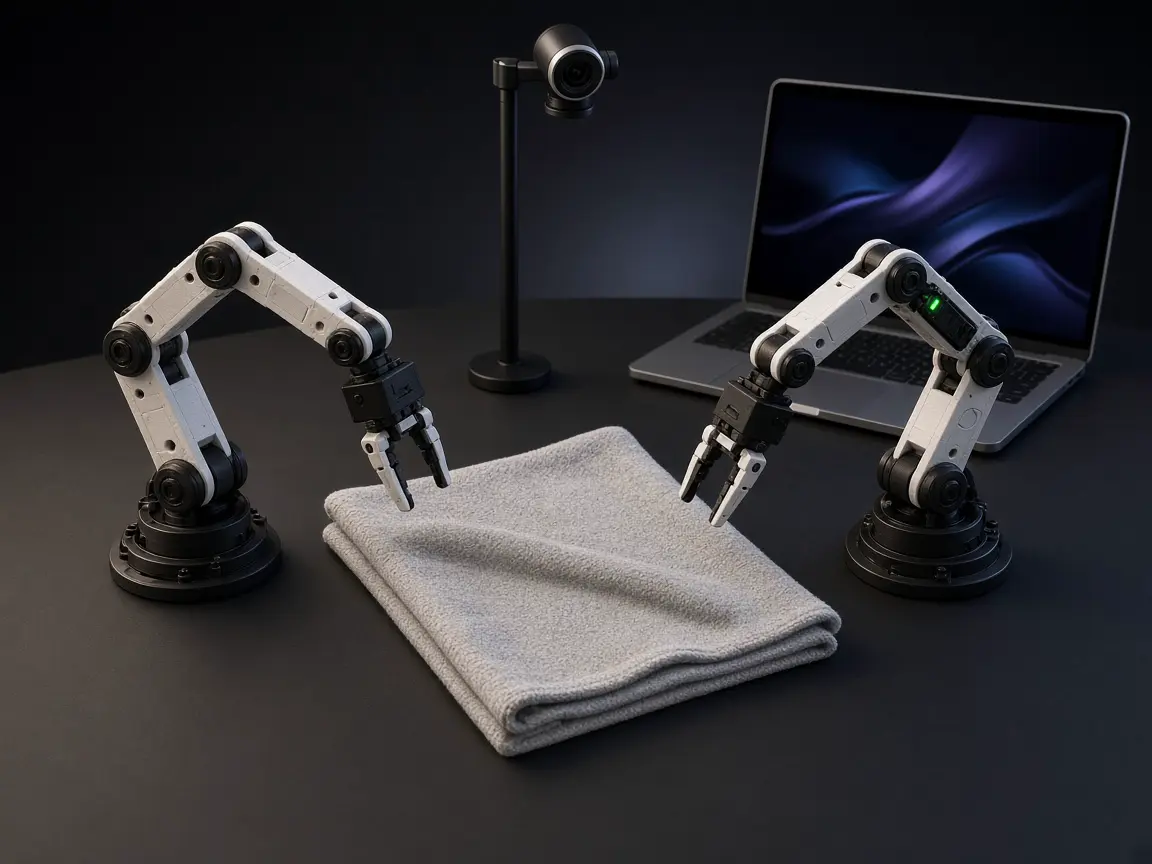
See how it goes together
The cheap setup is two SO-101 follower arms facing each other over the towel, a small camera on each wrist and one USB camera looking down from above. The exploded view names every part.
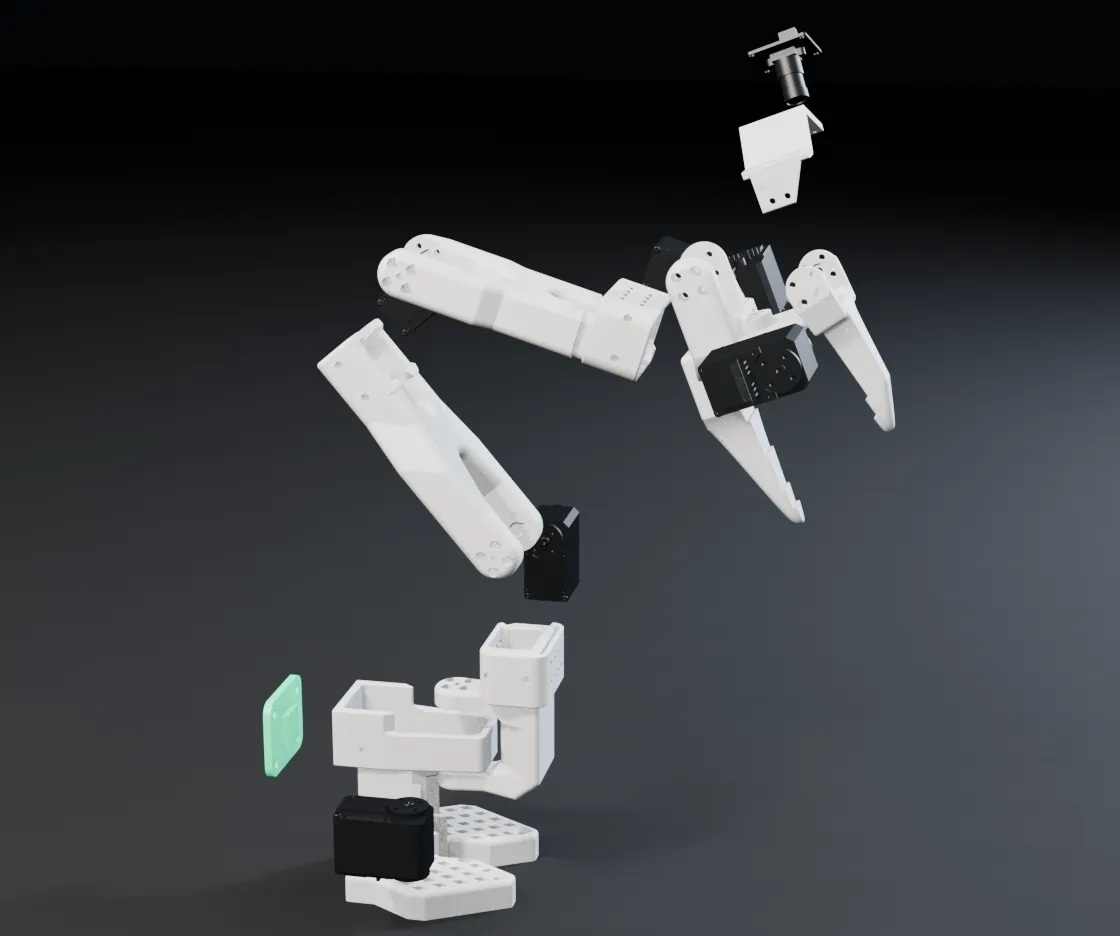
The parts of one follower arm. White parts are 3D printed. The black blocks are its six STS3215 servos.
- 1Base. Clamps to the desk.
- 2Servo driver board mount. Holds the small board that talks to all six servos.
- 3Shoulder. Turns the whole arm left and right.
- 4STS3215 servo. One of six. Each joint and the gripper gets one.
- 5Upper arm
- 6Forearm
- 7Wrist. Bends and rolls the gripper.
- 8Gripper. The fixed jaw.
- 9Moving jaw. Opens and closes to pinch the towel.
- 10Wrist camera. Sits on a small printed mount.
What works and what doesn't
Works now, on a hobby budget
Folding a flat towel with two SO-101 arms and an ACT policy you train on 50 or so of your own demos. People have published datasets of exactly this, with 100 and 600 episodes. None of them report a success rate we could check, so plan on a few rounds of record, train, test.
Works, with a big budget
T-shirts. The Hugging Face team folded them at 90% over 20 filmed trials on a $6,500 bimanual OpenArm, after about 131 hours of demos and more than 5,000 GPU hours. They released the model, the data and the recipe.
Not yet
A basket of mixed, crumpled clothes in and a neat stack out, on hardware you can buy. Physical Intelligence has shown it on its own robots, and Figure has a humanoid folding towels from a pile. Both are closed. Two consumer folding machines that tried, Laundroid and FoldiMate, shut down without shipping.
How the parts fit together
You teach the robot by doing the fold yourself through a pair of leader arms. The follower arms copy you while cameras record. A GPU turns those recordings into a policy, and the policy then drives the follower arms on its own. The software for all of it is LeRobot, Hugging Face's open-source robot learning library.
Pick a setup
Cheap: two SO-101 pairs
About $550 to $610
2 self-sourced pairs ($459.76) or 2 WowRobo kits ($518), plus about $92 of cameras. Before 3D printing and tax.
- Hardware
- Two SO-101 followers clamped to a table, two leader arms, two wrist cameras and one overhead camera, all on USB to one laptop.
- Policy
- ACT, trained on your laptop GPU (about 30 to 60 min on an RTX 4090 for 50 episodes) or a rented GPU.
- Goal
- A flat towel, folded in half or in quarters.
- Time
- Two arms take about 1.5 hours to assemble (XLeRobot docs), so four is an afternoon. Then evenings of recording.
- Difficulty
- Beginner friendly if you can follow a wiring guide.
Sources: SO-ARM100/101 repo (TheRobotStudio), WowRobo SO-ARM101 kit, XLeRobot bill of materials, LeRobot compute and hardware guide
Mid: XLeRobot
About $660 to $800
The $579 kit (arms plus base) leaves out the battery and the IKEA cart, listed at $179.99 and $39.99 in the parts list, which brings the kit route to about $800. The self-sourced estimate of about $660 uses your laptop and one head camera, and leaves out printing, tools, shipping and tax.
- Hardware
- Two SO-101 style arms on a wheeled IKEA cart base with a head camera. Teleop by keyboard, Xbox controller, Joy-Con or Quest 3 VR, or a leader arm.
- Policy
- ACT or SmolVLA. SmolVLA wants about 10 to 16 GB of VRAM, so most people rent an L4 or A10G.
- Goal
- Towels on a table, with room to grow into fetching the basket.
- Time
- Under 4 hours of assembly, the XLeRobot repo says. Then recording.
- Difficulty
- Intermediate. More motors, more cables, and the base adds failure points.
Sources: WowRobo XLeRobot kit, XLeRobot repo, XLeRobot bill of materials, LeRobot compute and hardware guide
Serious: bimanual OpenArm
$6,500 and up
OpenArm 2 bimanual from WowRobo ($7,300 with the top stereo camera), plus OpenArm Mini leader arms at about €120 to €150 each.
- Hardware
- The setup Hugging Face used for t-shirts: bimanual OpenArm, OpenArm Mini leaders, one base camera and two wrist cameras. CAN bus motors.
- Policy
- π0 or π0.5 fine-tuned from a pretrained checkpoint. A LoRA fine-tune in openpi needs more than 22.5 GB of VRAM; a full fine-tune needs over 70 GB.
- Goal
- T-shirts, laid out or messy.
- Time
- Months. The Hugging Face team logged about 1,900 engineering hours.
- Difficulty
- Hard. You are now running a small research project.
Sources: WowRobo OpenArm 2, OpenArm Mini leader arms repo, Unfolding Robotics (Hugging Face), openpi (Physical Intelligence)
Start cheap. The same LeRobot commands drive all three, so your skills and code carry over if you upgrade.
Parts list for the cheap setup
USD, as listed on each source page on Oct 23, 2026. Shipping and tax not included.
| Part | Qty | Price | Source |
|---|---|---|---|
| SO-101 arm pair (1 leader + 1 follower)US parts list in the repo. Excludes 3D printing. | 2 pairs | $229.88 a pair, self-sourced | SO-ARM100/101 repo (TheRobotStudio) ↗checked Oct 23, 2026 |
| Or: SO-101 kit, unassembled (1 leader + 1 follower + 1 camera)Printed parts included. $299 assembled. | 2 kits | $259 a kit | WowRobo SO-ARM101 kit ↗checked Oct 23, 2026 |
| STS3215 servo (spare)The follower arm uses 6. Leader arms mix gear ratios. | 1 or 2 | $13.89 each | SO-ARM100/101 repo (TheRobotStudio) ↗checked Oct 23, 2026 |
| Wrist camera (small USB module)Price as listed in the XLeRobot parts list. | 2 | $12.98 each | XLeRobot bill of materials ↗checked Oct 23, 2026 |
| Overhead camera (Logitech C920)Price as listed in the XLeRobot parts list. Any steady USB webcam works. | 1 | $66 | XLeRobot bill of materials ↗checked Oct 23, 2026 |
| 3D printing (if self-sourcing)Depends on your printer or print service. Kits skip this. | 4 arms | Unknown | SO-ARM100/101 repo (TheRobotStudio) ↗checked Oct 23, 2026 |
| Laptop with an NVIDIA GPUACT needs about 2 to 6 GB of VRAM; a laptop RTX 3060 is fine. | 1 | Use what you have | LeRobot compute and hardware guide ↗checked Oct 23, 2026 |
| Or: rented GPU for trainingHugging Face hardware prices. A free Colab notebook exists for ACT; free-tier limits not checked. | a few hours | From $0.40/h (T4), $0.80/h (L4) | Hugging Face pricing (GPU per hour) ↗checked Oct 23, 2026 |
Step by step
1. Learn the loop before you buy anything
Install LeRobot, read the free Robot Learning Tutorial, and open a towel-folding dataset in the visualizer to see what a demo looks like: camera frames plus joint positions, usually 30 times a second.
pip install lerobot
LeRobot on GitHub, Robot Learning Tutorial (Hugging Face), LeRobot dataset visualizer
2. Build and calibrate the arms
Print or buy the parts, set each servo's ID, then calibrate every arm. The SO-101 guide walks through both leader and follower.
lerobot-find-port
lerobot-setup-motors ...
lerobot-calibrate ...
3. Teleoperate both arms
Move the leader arms and the followers copy you. LeRobot has a two-arm SO-101 setup built in (bi_so_follower with bi_so_leader). Practice until the folds look clean; early demos are worse than later ones.
lerobot-teleoperate --robot.type=bi_so_follower --teleop.type=bi_so_leader ...
LeRobot: imitation learning on real robots, LeLab, a web UI for LeRobot
4. Record 50 or more demos
Fix the cameras, use the same towel and table, and fold the same way each time. LeRobot suggests at least 50 episodes; the Hugging Face folding team suggests 30 to 50 clean demos per item and background.
lerobot-record ... --dataset.single_task="Fold the towel in half" --dataset.num_episodes=50
LeRobot: imitation learning on real robots, Unfolding Robotics (Hugging Face)
5. Train a policy
Start with ACT. It is small and trains on a laptop GPU. On a CPU-only machine, don't train locally: use the Colab notebook or rent a GPU.
lerobot-train --dataset.repo_id=you/fold_towel --policy.type=act ...
LeRobot compute and hardware guide, LeRobot Colab notebooks, ACT paper (arXiv 2304.13705)
6. Let the policy drive
lerobot-rollout loads your trained policy, reads the cameras and joints, and sends joint targets to the followers. Film every run so you can see where it fails, then record more demos of exactly those moments.
lerobot-rollout --strategy.type=base --policy.path=you/my_policy ...
7. Level up: bigger models, smoother motion
Try SmolVLA or π0.5 once ACT works. Real-time chunking (RTC) overlaps thinking with moving, which helps slow models. Relative actions and a reward model (SARM) were big wins in the Hugging Face t-shirt project.
SmolVLA paper (arXiv 2506.01844), LeRobot real-time chunking, Unfolding Robotics (Hugging Face), openpi (Physical Intelligence)
The commands are shortened. The LeRobot imitation learning guide has the full flags for ports, cameras and the Hub. Prefer a browser UI? Try LeLab.
Folding demos and open data
- Unfolding Robotics: t-shirt folding ↗
Hugging Face LeRobot team, 2026
Bimanual OpenArm with OpenArm Mini leaders, three cameras, π0/π0.5 fine-tunes. 90% success over 20 rollouts: 100% on laid-out shirts (40.8 s average), 80% on messy shirts (95.9 s). About 131 hours of demos and over 5,000 GPU hours.
Open: model, both datasets, hardware files, recipe. Model, Full dataset, High-quality dataset
- π0-ALOHA-towel checkpoint ↗
Physical Intelligence, 2025
An open checkpoint in openpi that "can fold diverse towels 0-shot on ALOHA robot platforms." Inference needs a GPU with more than 8 GB.
Open: code and weights. The repo warns it may or may not work on your setup.
- π0 laundry folding ↗
Physical Intelligence, Oct 2024
A fine-tuned π0 takes crumpled clothes from a bin, folds them and stacks them, on a fixed two-arm robot and on a mobile robot that unloads a dryer first.
Closed robot, paper public. The base π0 weights were opened later. π0 paper (arXiv 2410.24164)
- Helix folds towels ↗
Figure, Aug 2025
A Figure 02 humanoid with multi-fingered hands picks towels from a pile and folds them, end to end from camera to motors.
Closed.
- Community towel-folding datasets on SO-101 arms ↗
Hugging Face Hub users, 2025 to 2026
Public LeRobot datasets of people teleoperating two SO-101 arms to fold towels: 100 episodes with 3 cameras, and 603 episodes with 4 cameras. There's also a 50-episode XLeRobot set. None publish a success rate we could check.
Open datasets. 100-episode two-arm set, XLeRobot set
Folding machines that didn't make it
- Laundroid ↗ , Seven Dreamers, Bankrupt Apr 2019
A $16,000 cabinet that took 5 to 10 minutes per shirt. It never shipped.
- FoldiMate ↗ , FoldiMate, Inc., Shut down 2021
You clipped each garment in by hand. It never reached mass production, and deposits were refunded.
Open problems you can help with
Getting from a pile to a flat item
Folding a laid-out shirt hit 100% in the Hugging Face tests; starting from a messy shirt dropped to 80% and took more than twice as long.
How to help: Record and share demos that start from a crumpled towel, not a flat one.
Cloth doesn't simulate well
The Hugging Face team says simulators can't reproduce how fabric crumples and slides, and world models can't yet predict it, so real teleop data is the only practical path today.
How to help: Every clean, well-labeled real dataset you upload helps. Put the task name and camera layout in the card.
Nobody reports cheap-arm success rates
There are hundreds of public SO-101 towel episodes, but we found no published success rate for a policy trained on them.
How to help: Run 20 filmed trials, count the successes, and post the numbers with the video.
Gripping fabric
The t-shirt project on OpenArm needed custom gripper jaws with a bigger contact patch to grip, pinch and slide fabric.
How to help: Design a printable cloth-friendly jaw for the SO-101 and share the files.
Big models need big GPUs
π0-class fine-tunes need more than 22.5 GB of VRAM even with LoRA. ACT fits a laptop but is a much smaller model.
How to help: Compare ACT and SmolVLA on the same towel dataset and share what each one gets right.
What we couldn't confirm
- Success rates for any policy trained on the public SO-101 towel datasets.
- Whether the free Colab tier is enough to train ACT. The notebooks page says ACT takes about 1.5 hours on an A100.
- Whether the Hugging Face t-shirt model works on a different robot or camera layout.
- 3D printing cost, the price of a Quest 3 for XLeRobot VR teleop, and exactly what ships in each OpenArm kit.
- Prices change. Check the source before you buy.
Papers behind the policies
ACT paper (arXiv 2304.13705), Diffusion Policy paper (arXiv 2303.04137), SmolVLA paper (arXiv 2506.01844), π0 paper (arXiv 2410.24164)